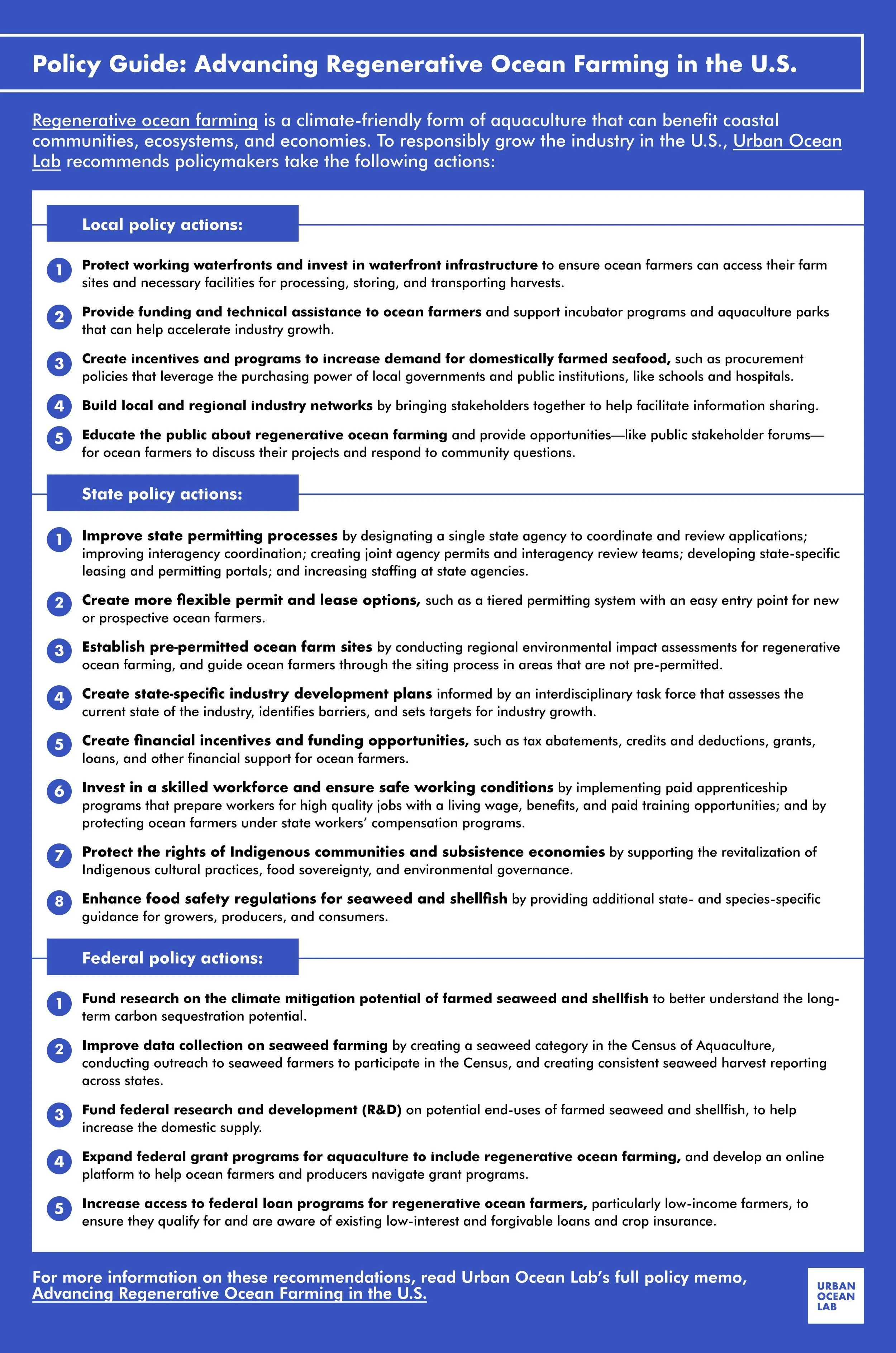
Policy Guide: Advancing Regenerative Ocean Farming in the U.S.
Regenerative ocean farming is a climate-friendly model of aquaculture where seaweeds and/or shellfish are grown in a way that requires no freshwater, feed, or fertilizer. Expanding seaweed and shellfish farming in the U.S. can create jobs and wealth for coastal communities, and provide an opportunity for fishers to diversify their income. Regenerative ocean farms have the potential to increase local food security and nutrition by supplying a sustainable source of seafood rich in protein and nutrients. Farmed kelp and seaweed canopies can help dampen wave energy and protect coastlines from erosion and coastal storms. Regenerative growing practices can help improve coastal water quality and increase local biodiversity: Seaweed and shellfish can absorb excess nutrients (such as nitrogen, phosphorus, and carbon), and help to mitigate harmful algal blooms, deoxygenated dead zones, and local ocean acidification.