

OFFSHORE WIND ENERGY
Current Status: The United Kingdom, China, and Germany lead the world in offshore wind power with 10.2 gigawatts (GW), 10.0 GW, and 7.7 GW in operation respectively. Meanwhile, there are just two operational offshore wind facilities1 in U.S. waters, generating a combined 42 megawatts (MW) of power.
Potential: State and federal waters along the continental U.S., Hawaii and the Great Lakes, have the technical potential to supply more than 2,000 GW of offshore wind power – approximately twice the nation’s current electricity generation capacity. While only a portion of this potential will realistically be developed, offshore wind could nevertheless be a significant part of the U.S. energy mix.
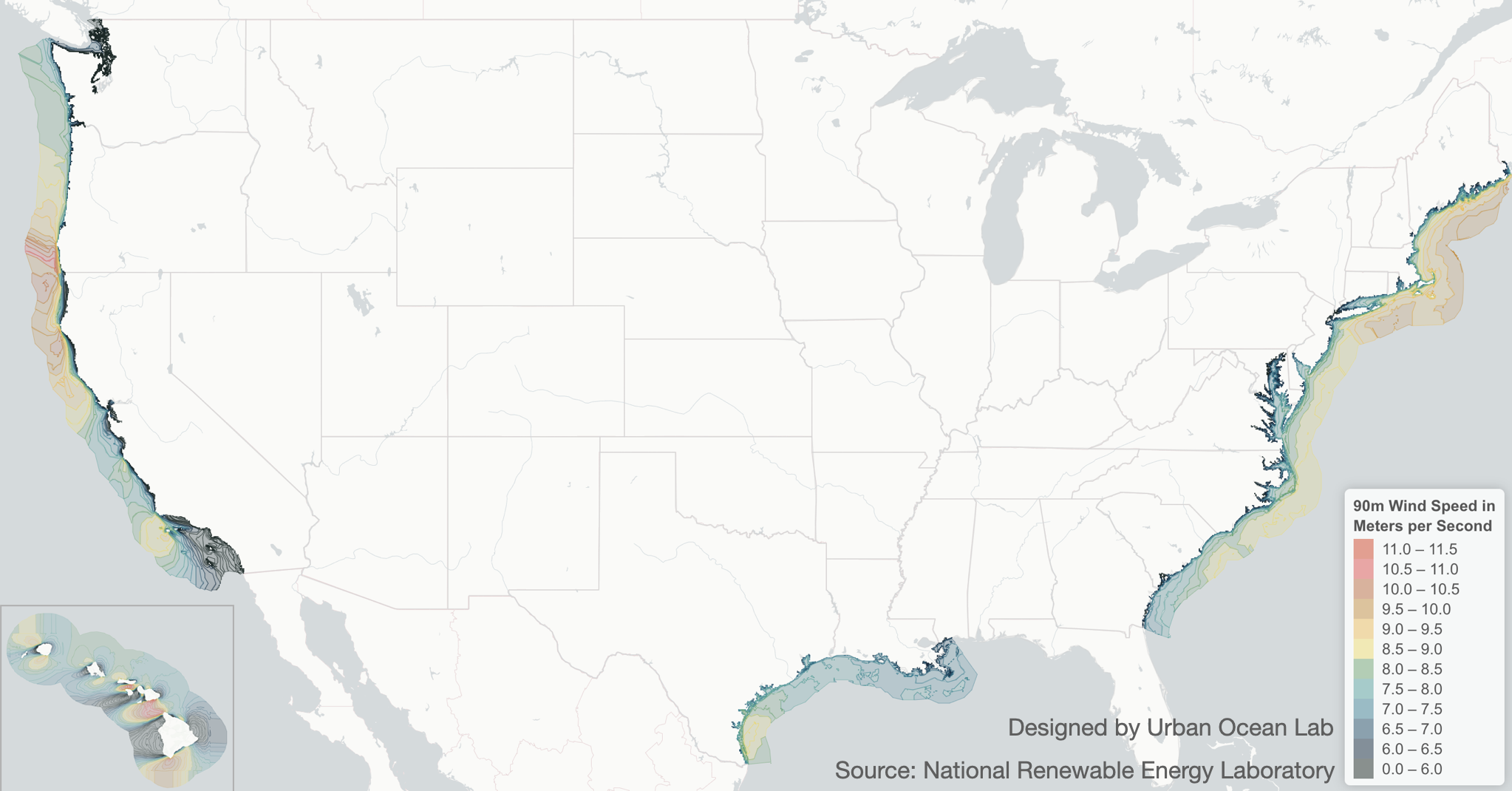
Reliable: Offshore wind is stronger and more consistent than onshore wind, so it has fewer intermittency issues than onshore wind or solar.
Cost Competitive: Offshore wind power has the potential to become less expensive than non-renewable power generation.
Shorter Transmission Distances: With 40% of Americans living in coastal counties, offshore wind projects present an opportunity to generate renewable energy close to high-demand areas.
Job Creation: Offshore wind has the potential to support an average of 80,000 jobs per year from 2025 to 2035 in the U.S., including many union jobs and jobs that require skills easily transferable from the oil and gas sector. That’s 60% more jobs than the coal mining industry provided in 2019.
Strong Public Support: U.S. voters support the construction of new offshore wind farms by a 48-percentage-point margin, with support from 66% of Republicans and 72% of Democrats.
How do Offshore Wind Farms Work?
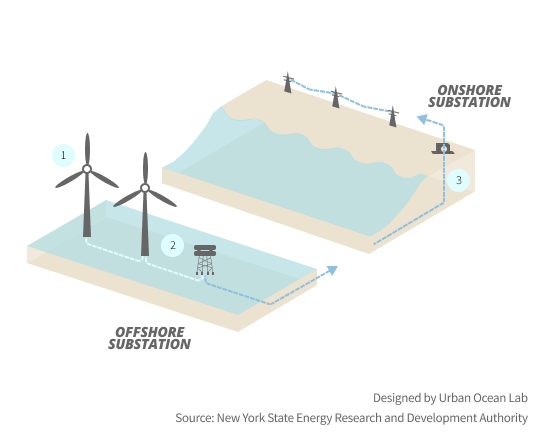
- Offshore Turbines capture the wind's energy and generate electricity.
- Foundations secure turbines to the ocean floor and cables transmit electricity to an offshore substation.
- Electricity flows through a buried cable to an onshore substation and is transferred to the existing transmission network.2
| CHALLENGES | SOLUTIONS |
|---|---|
| Complex offshore governance and permitting processes can take up to 9 years | Increase staffing and efficiency at the Bureau of Ocean Energy Management (BOEM) |
| Lack of a well-designed transmission system to connect offshore electric cables to the onshore electric grid | Create an interagency offshore wind task force, in coordination with the Federal Energy Regulatory Commision, to develop a cohesive national offshore wind transmission master plan |
| Ecological impacts on marine environment and limited scientific data about cumulative impacts of wind farms | Establish a fund, via Congress, to support research into and to mitigate the environmental impacts of offshore wind |
| Opposition from the fishing and shipping industries and coastal communities | Site offshore wind farms in areas that minimize disruptions to other industries and ensure that communities hosting offshore wind development benefit economically, via collaborations between the Department of the Interior and regional planning bodies |
State Offshore Wind Projects and Targets
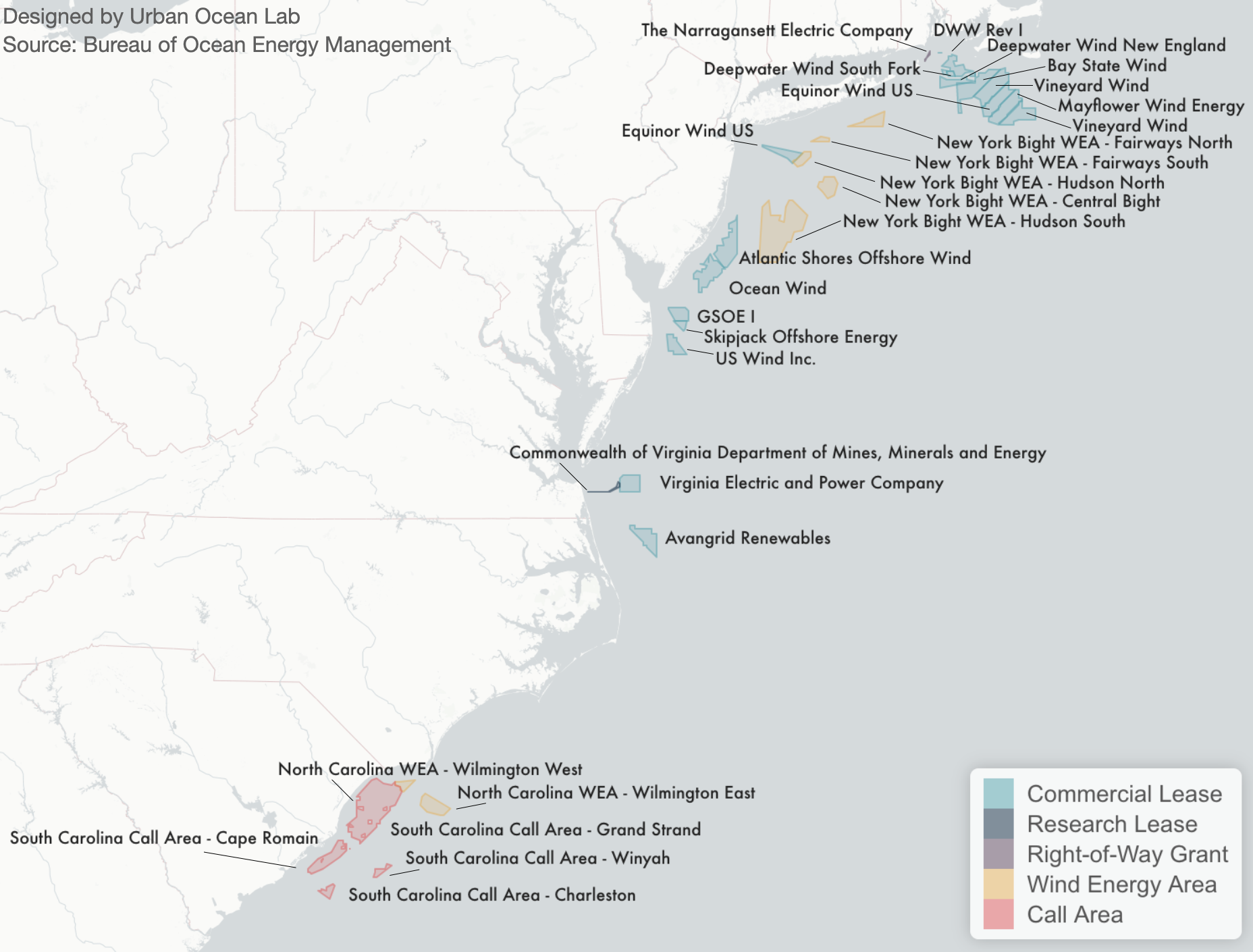
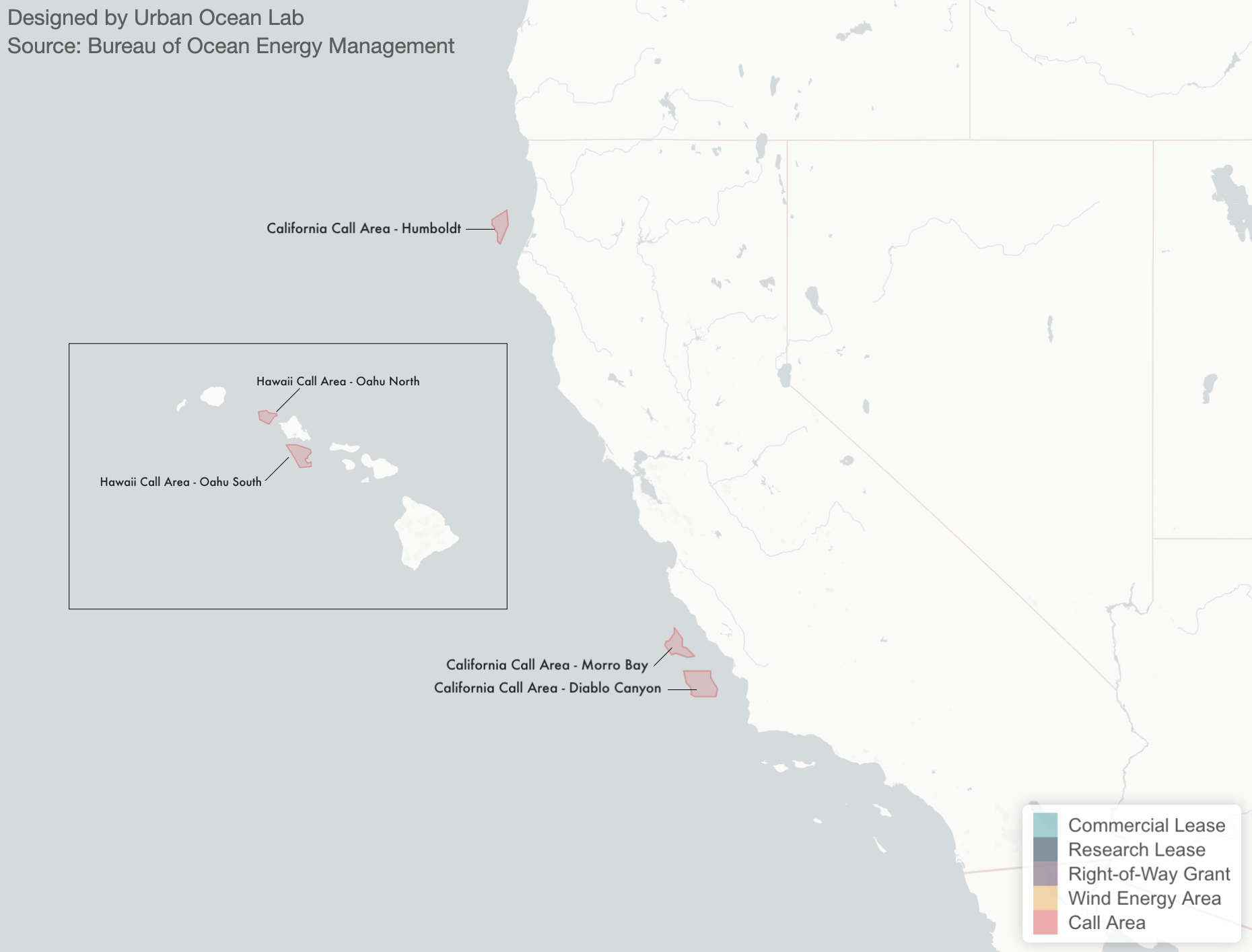
As of April 2021, BOEM has issued 16 active commercial wind energy leases, which could power nearly 8 million homes. State procurement goals along the Eastern seaboard have driven the emerging U.S. offshore wind market. Leasing areas in other regions of the country, including off the coasts of California, Hawaii, as well as in Lake Eerie are in various stages of planning and development.
| STATE | OFFSHORE WIND GOAL (MW) |
|---|---|
| Massachusetts | 5,600 by 2035 |
| Rhode Island | 1,000 by 2030 |
| Connecticut | 2,000 by 2030 |
| New York | 9,000 by 2035 |
| New Jersey | 7,500 by 2035 |
| Maryland | 2,000 by 2030 |
| Virginia | 5,200 by 2034 |
| Total | 32,300 MW |
Feats of Engineering
Floating wind turbines: Wind turbines in shallower water are usually fixed to the seabed using steel piles or lattice structures – though shallow water does not necessarily mean close to shore.3 However, 58% of the nation’s offshore wind resources are in waters too deep for these bottom-mounted foundations to be economically viable. The wind industry is developing a variety of foundations, including floating platforms,4 that are optimal for the depth at each site.

Incredible heights: Taller towers provide access to steadier, higher wind speeds and enable larger blades which can capture more wind energy. Turbines can be 1.5 times as tall as the Washington Monument and have blades the length of a football field.
Notes
- The 30 MW Block Island wind farm off the coast of Rhode Island has been operational since 2016. The 12 MW Coastal Virginia Offshore Wind project, phase one of a potential 2600 MW project, was completed in June 2020.
- From Offshore Wind 101, presented by the New York State Energy Research and Development Authority.
- BOEM studies aesthetic and recreational impacts when siting offshore wind projects in order to avoid potential eyesores or disruptions. Leasing areas recently awarded to the developer Ørsted are 15-35 miles from shore.
- A $100 million floating offshore wind project 14 miles off the coast of Maine is set to begin construction in 2023. The project is funded by RWE Renewables and Mitsubishi Corp. and uses technology developed by the University of Maine.