

regenerative ocean farming
WHAT IS REGENERATIVE OCEAN FARMING?
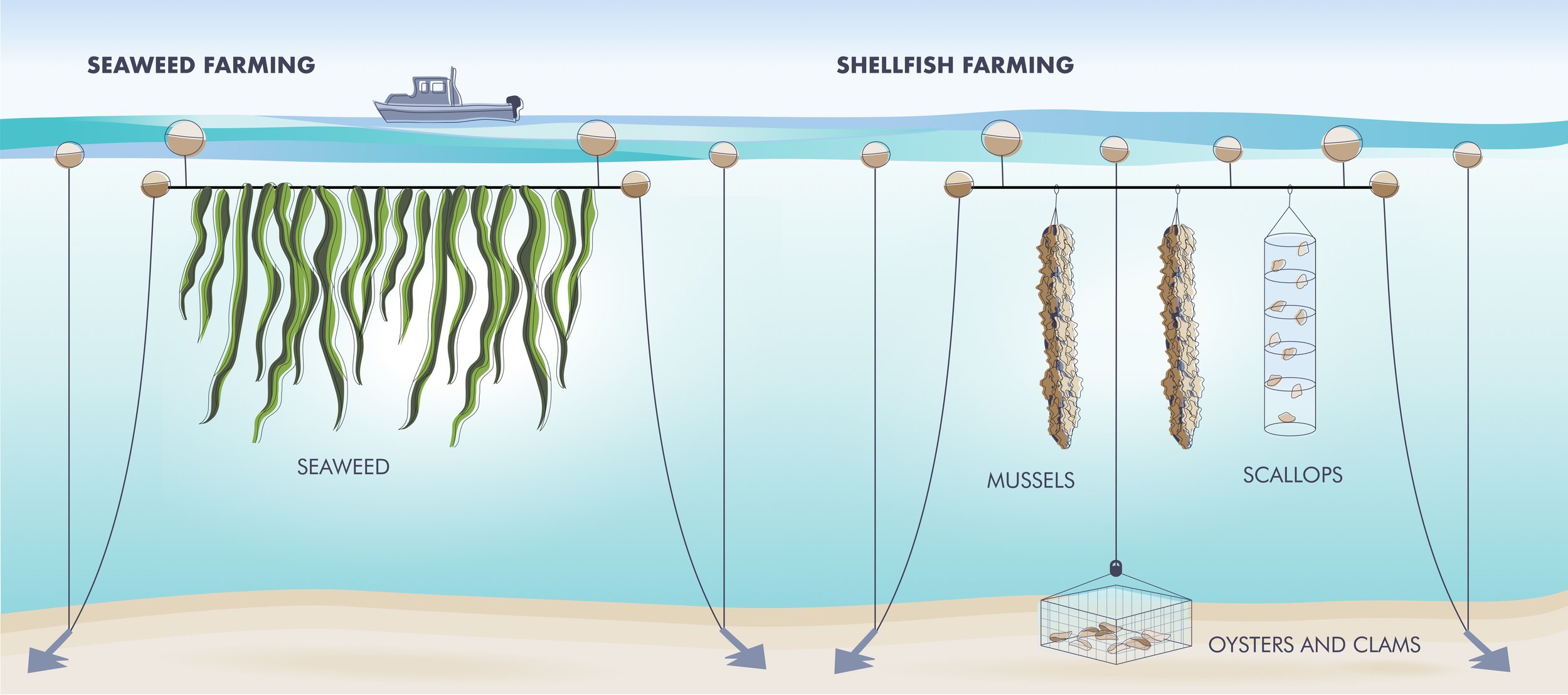
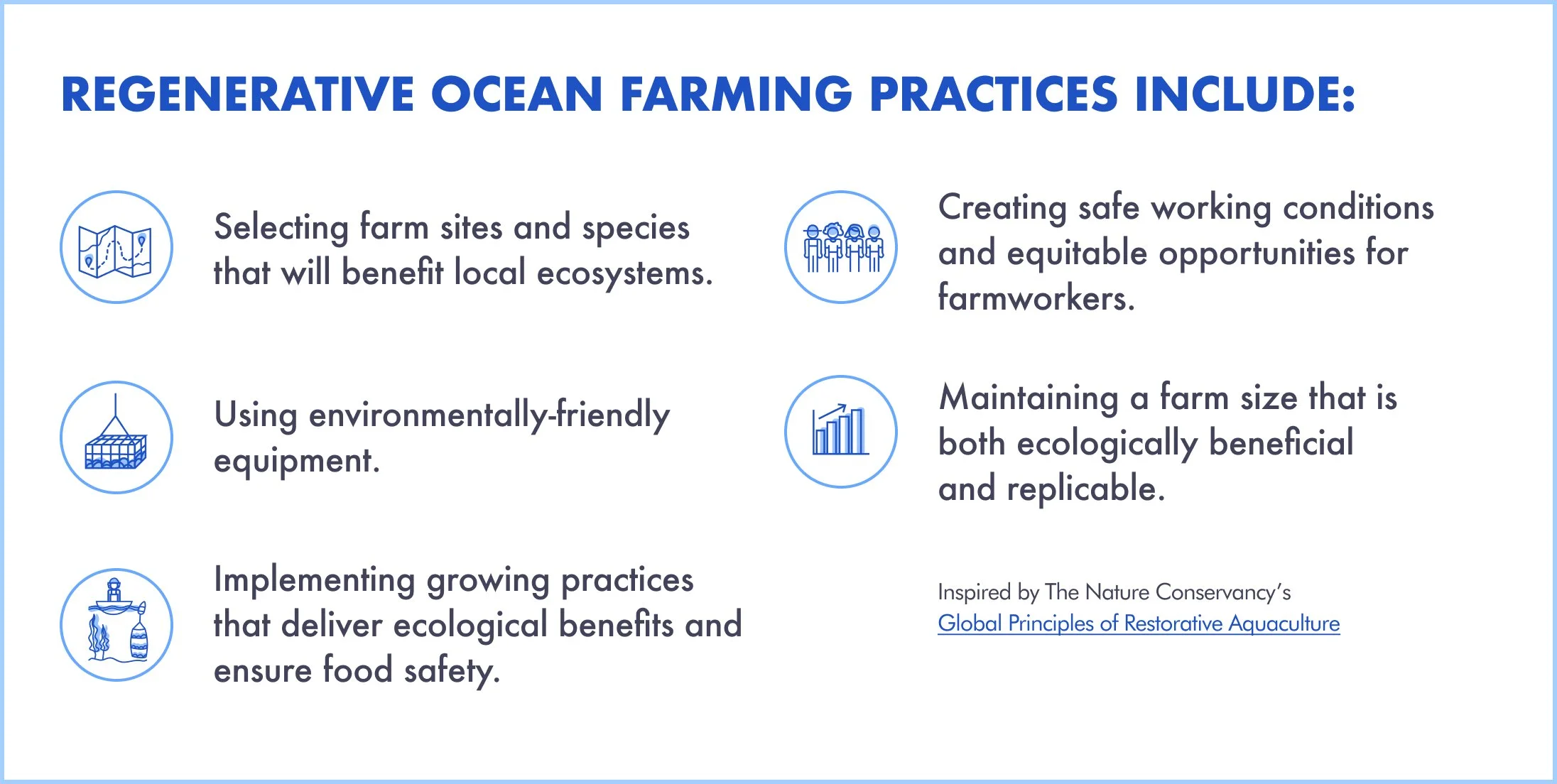
Regenerative ocean farming¹ is a climate-friendly model of aquaculture where seaweeds and/or shellfish² are grown in a way that requires no freshwater, feed, or fertilizer. This farming model can benefit coastal ecosystems and communities by increasing food security, creating jobs, improving water quality, protecting coastlines, providing a range of additional ecosystem services, and supporting ocean justice.
Some models of regenerative ocean farming rely on a polyculture system that uses the entire water column to co-cultivate a diverse mix of shellfish and seaweeds, while others may cultivate a single species. Climatic conditions determine which species can be grown where and when.
Farming and harvesting the seas while restoring local ecosystems is by no means a new practice. Indigenous communities across the world have been sustainably harvesting and farming coastal environments for thousands of years. Bivalves (such as oysters and clams), fish, and seaweed have a long history of traditional cultivation for use in food, medicine, ceremonies, and coastal protection.
why does it matter?
Ocean health is in decline due to climate change. Greenhouse gas emissions have caused ocean temperatures to warm by about 1.5° Fahrenheit, acidity to increase 30%, and oxygen levels to decrease 2%, affecting ocean productivity and biodiversity. Climate change has also led to a reduction in commercially important seafood species and could lead to a mass extinction of marine life.
Many industrial fish farms and wild-caught fisheries are unsustainable. Current industrial finfish aquaculture often uses socially and ecologically unsustainable methods, such as relying on wild fish to feed the farmed fish, further contributing to declines in ocean health. Fishing industry emissions are increasing while catch is decreasing. Further, the U.S. has a seafood trade deficit—importing 70-85% of our seafood, almost half of which is produced via unsustainable aquaculture abroad.
The seaweed and shellfish aquaculture market is growing. Global shellfish aquaculture production increased ten-fold from 1985 to 2018, and has continued to grow. Similarly, the seaweed industry has experienced rapid growth in recent decades, and is expected to continue. As of 2019, up to 48 million square kilometers of ocean (around half the size of the Atlantic Ocean) was deemed suitable for seaweed aquaculture. The global commercial seaweed market is expected to surpass $95 billion by 2027.
WHAT ARE THE BENEFITS?
The potential to mitigate climate change. Seaweed can absorb massive amounts of carbon; however, further research is needed to quantify the carbon capture and removal of farmed seaweed and shellfish, especially long-term sequestration potential. Regenerative ocean farms can reduce the need for land-based agricultural practices that have larger carbon footprints—for example, shellfish aquaculture produces 20 times less emissions per kilogram of protein than beef production. By adding certain species of seaweed to the diets of livestock, farmers can cut methane emissions by over 80% in cows and up to 80% in sheep. Seaweed can also reduce emissions by acting as an alternative to fossil fuel-based products, including fertilizers and plastic packaging. The U.S. has the potential to produce enough macroalgae (including seaweed) per year to make biofuel that could meet roughly 10% of the nation’s annual transportation energy needs.
Protects shorelines. Farmed kelp and seaweed canopies can help dampen wave energy up to 33%, thereby protecting coastlines against erosion and coastal storms. Oyster reefs can also attenuate wave energy, which can reduce erosion along shorelines by up to 54%. Preliminary research shows that suspended mussel farms can help to dampen wave energy during storms, however, further research is needed on the capacity for farmed shellfish to protect coastlines.
Improves water quality and increases species biodiversity. Oysters, mussels, and clams are powerful filters—a single oyster can filter up to 50 gallons of water each day. Cleaner water can facilitate the growth of seagrasses and other habitats that are home to juvenile crabs, fish, and invertebrates, boosting local marine biodiversity. By absorbing excess nutrients such as nitrogen, phosphorus, and carbon caused by pollution and agricultural run-off, seaweed and shellfish can help mitigate harmful algal blooms, deoxygenated dead zones, and local ocean acidification.
Creates jobs and wealth for coastal communities. A fully scaled up regenerative ocean farming industry has the potential to generate 50 million direct jobs and 100 million associated jobs globally. Regenerative ocean farming can also provide an opportunity for fishers to diversify their income, especially important as capture fisheries decline. Fishers who farm kelp in the off season can realize an estimated 8% return on investment after 3 years, and earn $13.50 per hour greater income as compared to other off season jobs.
Increases food security and nutrition. Regenerative ocean farms have the potential to increase local food security if crops are consumed locally. Community Supported Fisheries are a way for community members to access nutritious seafood while creating a guaranteed market for local ocean farmers. Shellfish are not only a source of animal protein, they are also a source of amino acids and nutrients like vitamin B12, iron, calcium, and zinc. Seaweeds are also rich in protein and vital nutrients like vitamin C, iron, and iodine.
what can we do?
Supporting the sustainable growth of the regenerative ocean farming industry requires research, investment, and policies designed to help lower the barriers to entry, grow the industry equitably, and prioritize the health of ecosystems and communities while minimizing potential negative impacts. To support regenerative ocean farming, we can:
Improve permitting processes and regulations. Entry into the industry can be time consuming and costly due in part to complex and cumbersome regulatory and permitting processes that vary from state to state and involve multiple agencies across all levels of government. To improve permitting efficiency, state agencies need adequate funding and resources to increase staffing, improve inter-agency coordination, and develop permitting portals.
Invest in farms and a skilled workforce. Developing affordable training programs for seaweed and shellfish farmers can help increase access to resources and provide needed support. Incubator programs, like the Port of San Diego’s, can provide new and prospective ocean farmers with support such as subject matter expertise, market access, and funding. Financing and low-interest loans can help to ensure that regenerative ocean farming is accessible.
Increase market demand. Despite a rapidly growing seaweed industry, demand for seaweed is still lagging. Investing in the development of more seaweed-based products like kelp burgers and seaweed fertilizers can help support regenerative ocean farmers by increasing demand for their crops. Advancements in processing technology propelled by research and development can further support industry growth.
Fund further studies into benefits and impacts. More research on the potential positive and negative ecological and socio-economic impacts of scaling regenerative ocean farming is necessary, including further research on the long-term carbon sequestration potential of farmed seaweed and shellfish.
Protect working waterfronts and small-scale farms. Funding the revitalization of working waterfronts that offer co-operative infrastructure (including shared equipment, processing facilities, and storage) can help small- to medium-scale ocean farmers access and compete in wider markets while helping to sustainably grow the industry.
Notes:
¹ While terminology varies, for the purposes of this factsheet Urban Ocean Lab has adopted a definition for ‘regenerative ocean farming’ that closely aligns with the practices of restorative aquaculture. Alternative, related terms often involve a combination of “restorative,” “shellfish,” or “seaweed” and “ocean farming,” “aquaculture,” or “mariculture.” Related concepts include conservation aquaculture, integrated multi trophic aquaculture, and low trophic marine aquaculture.
² This factsheet focuses on shellfish and seaweed farming because of the numerous scientific studies indicating restorative outcomes for cultivating these species.